
Phone(613) 9898 5319
Phone(613) 9898 5319

admin 03 Aug 2026
If your local council, sports club, or school is still using metal halide lighting systems, then you are not alone. However, the rising costs of electricity supply and maintenance, along with stricter demands for quality illumination, have led many organisations to consider upgrading their old lighting systems.
The selection of LED vs. metal halide inside sports venues goes way beyond simply replacing old equipment. Today’s LED lighting systems give much better results in terms of light output, visibility, energy efficiency, service life, and maintenance.
At SES Lighting, we can share plenty of first-hand experience we obtained while overcoming challenges related to the replacement of old lighting systems. Through the years of successful operations, we have already helped local football ovals, netball lighting, tennis courts, and other types of venues become illuminated and bring in real money savings.
There is a need to understand both technologies before any lighting upgrades can be implemented. Different technologies work differently when it comes to lighting.
The metal halide bulb produces light by the passage of an electric current through a gas-filled arc tube. Many old tracks and community fields use this kind of lighting equipment.
But these systems have some drawbacks. They take a long warm-up time to reach full brightness, use a lot of electricity and fade slowly over time.
The LEDs produce light instantly as they allow the current to pass through semiconductor chips. Current sports lighting technology relies on the high efficiency of these diodes. The increase in its uptake across the sporting facilities in Australia is spectacular.
One important aspect of LED sports lighting benefits is that the lights turn on immediately, giving better lighting control, and remain bright for a long time, unlike metal halide lights.
|
Feature |
LED Sports Lighting |
Metal Halide Lighting |
|
Energy efficiency |
Excellent |
Moderate |
|
Light quality |
Bright, even illumination |
Can become uneven over time |
|
Warm-up time |
Instant |
10–20 minutes |
|
Lifespan |
Up to 50,000+ hours |
Around 10,000–20,000 hours |
|
Maintenance |
Low |
Frequent lamp replacement |
|
Operating costs |
Lower |
Higher |
|
Light control |
Easy dimming and smart controls |
Limited control |
The key incentives for the sports clubs to choose sports field lighting upgrade is to attain a reduction in electricity consumption as well as expenses.
LED lights are known for consuming much less power than conventional lighting but still giving the same or even better light intensity. Additionally, LED lights are very efficient, as they produce light with less heat.
Hence, using this type of sports lighting energy savings method enables substantial savings on total energy consumption in electricity for those facilities which play every day or have some sports events on weekends.
For instance, community football clubs that use field lights for four evenings in a week would benefit a lot by switching to an LED lighting system, as they will dramatically decrease their annual electricity bills. Despite the fact that the actual savings depend on the size and utilisation of the stadium, lower consumption will ensure savings from year to year.
The importance of light quality goes beyond enabling players to see their game. The quality of lighting impacts the players’ level of performance, safety and experience whenever they are at the site. Modern systems of LED lighting provide the following:
Stable light enables players to estimate their distance and speed correctly and reduces shadows that impact the game process. For officials and spectators, having good lighting means a good experience when watching a game at night.
Keeping the lighting system functioning represents significant costs and lots of resource consumption. Lower sports lighting maintenance costs can include the following:
Replacement of lamps: As metal halides burn out very fast and require constant replacing of bulbs, LEDs can function for years without burnout of bulbs.
Maintenance frequency: Old systems require checking and adjusting constantly, while LED systems need no maintenance once installed.
Downtime: In case of any failure of the lighting system, all the training sessions and competitions will be cancelled. LED systems are reliable and do not have any failures.
Meeting national requirements is necessary to ensure the compliance of sporting events. The council demands strict compliance with glare control and consistency concerning noise impact on neighbours. Each level of competition is subject to its own specific brightness limits.
With today\'s advanced LED technology, compliance has become much simpler. These systems have excellent optics and refined controllability. By upgrading its lighting, your company may still improve the system and avoid fines while providing its venues for training and competitions.
Actual instances demonstrate the effectiveness of the upgrade.
Example 1: Community Football Field
Electric costs become lower due to modernisation. Replacement and maintenance of the lamp are eliminated almost completely from the budget. The ownership cost over a period of 10 years is always lower for LEDs.
Example 2: Tennis Club
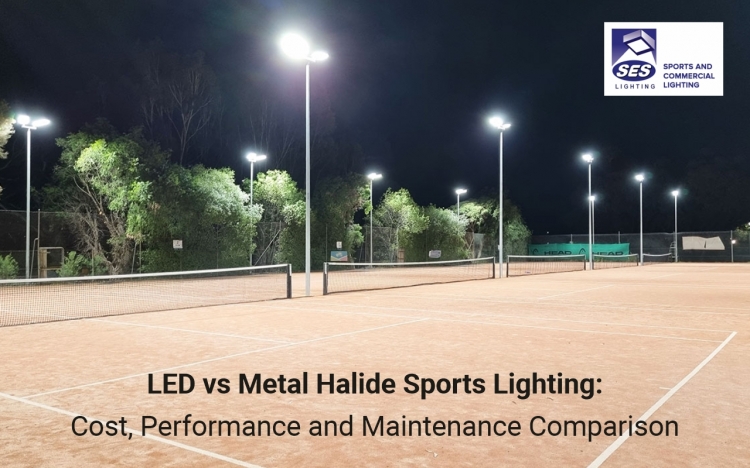
The quality of light greatly increases during night tournaments. Reasonable prices of electricity allow keeping the membership fee low. High-quality tennis lighting makes the members happy.
Example 3: Netball Centre
An equal amount of illumination everywhere helps to play fairly. Glare-free light helps to avoid missing a throw. The low cost of maintenance makes such upgrades very popular in netball.
Choosing a suitable lighting supplier is just as significant as selecting the perfect lighting technology.
At SES Lighting, we collaborate with sporting teams, educational institutions, councils, and businesses to provide dependable sports lighting solutions which meet the needs of every individual project. From lighting design and product selection to installation support, the SES team assists customers in achieving efficient and effective systems.
There are many advantages to using LED technology for sporting lighting. Compared to metal halide, it also offers better energy efficiency, outstanding quality of lighting, and lower maintenance costs as well as long-term operating costs.
If initially the investment in LED lighting looks a little higher, the money saved on electricity consumption, maintenance, and prolongation of product life make this choice the most beneficial for sporting facilities in Australia.
Upgrading sports field lighting on a football field, tennis lighting and netball lighting into a modern LED lighting system will allow for obtaining better-quality light and safety measures for players while spending less money on operating the lights.
SES Lighting has all the necessary knowledge to help community game clubs and any other facility managers with making this change for the better. Contact us today!