
Phone(613) 9898 5319
Phone(613) 9898 5319

admin 06 Oct 2026
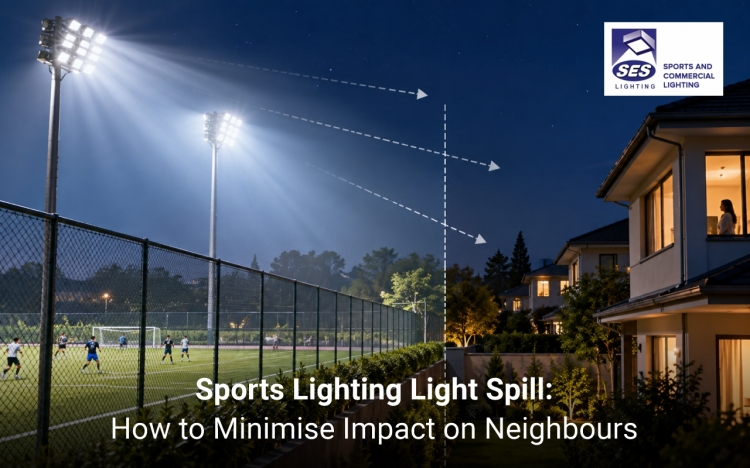
The significant aspect of good sports lighting is that it helps the players, officials, and spectators to easily view what’s happening on the field. However, when the light shines into houses, roads, and other spaces, it can create problems.
The light emitted in the unwanted destination is what we refer to as a sports lighting light spill. It affects neighbouring properties and causes glare, which constricts the efficient functioning of the sports facility.
Good sound planning and suitable equipment can help in cutting down the extent of the problem without compromising the visibility in the sporting field. In this blog, we will explore all the possible causes of sports lighting light spilling and ways to minimise it.
Light spill is the phenomenon in which some of the light produced by the sports lighting systems affects areas beyond the space that require light.
There are several reasons for this, such as:
A good outdoor sports lighting design allows for not only knowing where to use light but also where not to use it.
Beam angle is how effectively light gets dispersed from a fixture. Suitable angle selection allows light to be directed towards the court or field rather than spreading into adjacent areas.
For example, for illuminating a particular spot on a huge field, one can select a narrow beam while a wider beam can be used in areas needing ample light. The main thing is that the beam angle must correlate with the dimension and shape of the playing space. Wrong beam choice may lead to unnecessary lighting outside the safety border.
Asymmetric optics have the ability to focus the light only where it is needed. Rather than spreading evenly from the light source, asymmetric optics adjust the light distribution according to a specific pattern.
This concept may be useful in areas where sports activities take place next to houses and other sensitive locations. By utilising the right design, it is possible to concentrate the light on the playing field and avoid over-lighting the neighbouring areas.
The location of the lighting fixture is important in controlling light spill on or off the field. Fixtures should be positioned and aimed in such a way that they provide the needed light cover on the playing area without aiming at nearby houses or other unwanted areas.
In some cases it is better to raise the fixture up while in other cases it is better to change the angle or mounting position of the fixture. During the planning phase it is important to consider the environment, including buildings, roads and neighbouring properties.
Controlling light spill is important and similar to glare, but light spill and glare are not the same. Light spill means light hits places where it should not. Glares arise when there is too much brightness causing headaches and making it impossible to look.
Good lighting for sports must be bright enough to let players see well but not too bright to cause excessive glare when looking. Using high-quality lighting features, proper optics, and correct aiming can help in glare control. Shields and other glare-control accessories can also be used in specific cases. This is crucial if a sports facility is working at night since bright fixtures would be seen very well in the dark background.
A sports facility doesn't need to have every area lit with complete brightness all the time. Lighting controls can help clubs manage their lighting system according to how the area is being used. For instance, different lighting levels will be required for training and competitive sessions.
Use of timers, dimming systems, and zoning mechanisms will also ensure that lighting can only be used when required. For facilities which host different sports or events, it is important to design multipurpose lighting that can be adjusted for every situation.
Proper sports lighting is very important to light up the place. Ensuring there is light in the right place and in the right amount is more important than that.
At SES Lighting we assist sports clubs in creating an individual lighting system suitable for the area in question and developing appropriate solutions afterwards. We help in the proper selection of beam angles, using asymmetrical optics, placing fixtures properly, taking care of glare control, and using lighting control to reduce sports lighting spill.
Whether you are planning to install or lighting upgrade, SES lighting ensures the right outdoor sports design initially to avoid light spills or glare. Contact us today to enhance your sports field.